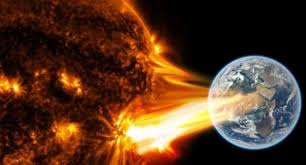
Intensive power from the sun, silences radio-signals.
Sun unleashes 2 colossal X-class solar flares, knocking out radio signals across the Americas and Pacific, Nov 5 2025.
The sun has fired off not one but two colossal X-class solar flares in less than 12 hours, causing radio blackouts across the sunlit portion of Earth at the time of eruption and marking a dramatic uptick in solar activity. The strongest eruption, was an X1.8-class flare and silenced many radio stations.
Sun unleashes strongest solar flare of 2025, sparking radio blackouts across Africa and Europe, Nov 11 2025.
The X5.1-class eruption from sunspot AR4274 is this year’s most powerful solar flare and Earth is in the firing line. The eruption peaked at 5 a.m. EST (1000 GMT). The blast triggered strong (R3-level) radio blackouts across Africa and Europe, disrupting high-frequency radio communications.The eruption peaked at 5 a.m. EST (1000 GMT) from sunspot AR4274. The blast triggered strong (R3-level) radio blackouts across Africa and Europe, disrupting high-frequency radio communications on the sunlit side of Earth.
Sun unleashes intense X-class solar flare, triggering radio blackouts across Australia, Dec. 8, 2025.
The sun erupted with a powerful X1.1-class solar flare in the early hours in Dec. 8, briefly knocking out radio communications across Australia and parts of southeast Asia. The solar flare occurred during an already active week on the sun. Several CMEs from earlier solar flares are forecast to impact Earth between Dec. 8-9.
What are solar flares?
Solar flares are caused when magnetic energy builds up in the sun’s atmosphere and is released in an intense burst of electromagnetic radiation.
They are categorized by size into lettered groups according to strength:
X-class: The strongest
M-class: 10 times weaker than X
C, B and A-class: Progressively weaker, with A-class flares typically having no noticeable effect on Earth.
What can we expect in the future?
2026 is widely expected to be a year of strong solar activity, because it coincides with the solar maximum of Solar Cycle 25. Current scientific forecasts point toward an active and energetic peak, with elevated levels of sunspots, solar flares, and coronal mass ejections.
While every solar cycle varies, scientists note that Solar Cycle 25 is showing stronger activity than originally predicted, and 2026 is likely to be its most intense year. The exact strength is always uncertain, but the consensus is clear: 2026 will be one of the most active years of this cycle.
The risk of radio blackouts will be higher in 2026, but not necessarily extreme every day. The year sits right inside the solar maximum of Solar Cycle 25, when the Sun naturally produces more M‑class and X‑class flares, the types most likely to disrupt radio communication.
What can we do? can we take any measure?
Solar flares and the radio blackouts they cause are not something we can prevent, but there are practical steps individuals, businesses, and even governments can take to reduce the impact. Think of it like preparing for a strong storm: you can’t stop it, but you can make sure you’re not caught off guard.
Prepare for temporary communication disruptions.
This is especially relevant for aviation, maritime operations, emergency services, and anyone using radio‑based communication. Airlines already reroute polar flights during strong solar storms to avoid radio blackouts. Pilots and dispatchers monitor space‑weather bulletins closely.
Power grid operators monitor geomagnetic activity and can reduce load to protect transformers. GPS providers issue accuracy warnings. Telecom networks adjust routing to minimize disruptions.
What cannot be done.
We cannot block or shield Earth from solar flares.
We cannot stop radio blackouts — only prepare for them.
We cannot predict every flare perfectly, though forecasts are improving.
Summary:
We can only hope that the sun will maintain its previous time rhythm of 11 years and that after 2026 there will be a calmer time. But there is also a tendency that our sun has entered a new phase and therefore it is difficult to predict the future.
Thanks for reading my blog.
#Windmush / #Curtbergsten