There has been an alarming development in the rise of social media. It all started with Six Degrees (1997) Friendster and Myspace(2003), which were later overtaken by Facebook(2004) and Twitter (2006, now X).
Ordinary people were given the opportunity to express their opinions or experiences to friends and acquaintances, which also opened the possibility of a new network of contacts all over the world, for those who wanted to.
The biggest breakthrough was Facebook, as the name suggests, your book with your face. This has later been abused with the help of fake images and identities. In addition to Facebook and Twitter, followers entered the competition.
Today we have: Flickr, Reddit, LinkedIn, Tumblr, Pinterest, Instagram, Quora, Snapchat, Telegram, Discord, Tik-Tok, Clubhouse, Bluesky You Tube and Google+. (Maybe even more?)
It has all developed into Big Business!
Unfortunately the economic impact thereby forgets the real people and members, behind the success, who have built this enormous network of contacts.
The first Big Business turmoil happened when Elon Musk bought Twitter and renamed it X, a brand that reflects his business empire, with many still continuing to call it Twitter, even though the purchase price was $44 billion.
Recently there are rumors of a new big purchase of the absolutely most popular media group, Tic-Tok! The American billionaire Frank McCourt has made a bid through his Project Liberty, which is not yet official, but it must be a gastronomic sum for the Chinese owner, ByteDance, to accept.
Challenging Big Tech
Frank McCourt is a former owner of the Los Angeles Dodgers and a construction and technology entrepreneur who wants to use his business to benefit society and therefore started Project Liberty a few years ago to counter Big Tech, which in his opinion has gone off the rails.
The constant surveillance, the exploitation of our data in a way we could never have imagined. The problem with social media that threatens our democracy by optimizing for polarization.
Media conflicts.
This development to improve the relationship between writers and companies has also been discussed in recent days by Facebook founder Mark Zuckerberg after pressure regarding free speech rights. This follows a number of attacks by Elon Musk and Donald Trump, who have criticized the right to censor in the media.
A significant reason for this discussion has its origins in Tik-Tok’s possible ban on publishing in the US market, as its government suspects that the Chinese government has political influence in Tik-Tok. This ban could possibly be lifted if an American owner of Tik-Tok becomes available.
In the midst of these great powers on the battlefield, writers and members of social media groups have a hard time making themselves heard. A utopia would be for EVERYONE to stop posting! But this is unlikely because it has all become a huge money game instead of a family network.
Finally, I would like to mention the danger that these social media pose to our new generation of children, who are constantly being manipulated, without control. Facial scanning should be introduced, so that younger children cannot access all the fake and other garbage posted by adults.
Let common sense convince the giant media owners to restore order. I am prepared to say a prayer, to that end.
Did you know that In 1939, at the end of the Civil War, Spain had been devastated by drought?
Dams needed to be built and became a priority for the Regime, especially in the 1940s, when Spain witnessed a even more heavy drought. The storage of water became a priority for the Regime, for agricultural use as well as for energy production.
The task of building dams under Franco was huge, and 615 dams were inaugurated from 1939 to 1975. Further projects were planned by engineers to connect water reservoirs with water tunnels, all over the country. This project never became a reality after Franco’s death in 1975, for political reasons.
I had the rare opportunity to see drawings of this extensive project in 1976, when I was living in Madrid. But I have since searched without success for these blueprints, which were probably destroyed to keep it all quiet.
The Franco regime presenting on of the dam-constructions 1956.
Drought is a cyclical natural phenomenon that has always affected our country, a transitory rainfall anomaly that can lead to an inability to meet the demand for water for irrigation or consumption. In the USA the most severe drought in its history occurred between 1933 and 1940, while in Spain the worst took place between 1941 and 1946, when the Manzanares River dried up completely and the Ebro became a small stream.
It is well known that the 40ºC threshold is surpassed every summer in some capital cities of Andalucia, such as Córdoba and Seville, as well as in other parts of the southern half of Spain. Even this value has been greatly surpassed on occasions. Thus, Écija (Seville) has recorded on different occasions the temperature of 47ºC (July 7th 1959, several days in July 1967, etc.). Likewise, in Seville 47ºC has been reached (August 6th 1946). During the heat wave in July 1995, Seville and Córdoba reached 46.6ºC. The record of 51ºC registered on July 30th, 1876!!
It is nothing new that Spain has had high temperatures, but which in today’s press hides the truth, by claiming that 2024 will have the worst heat period in history, and the global climate change is to blame. (information disseminated by the government).
Now in 2024, its tru that we are facing “similar” dry periods in large parts of southern Spain. Unfortunately, the current government has shown no greater interest in finding alternative solutions of this kind, as previously existed. Instead, responsibility is shifted to the EU Commission!
However, there are now a large number of solutions through desalination plants, land-based or floating, but this large costs that have not been prioritized in the state budget. The political governance is prioritized to meet social conditions, as well as the tourism industry, rather than adding costs to infrastructure. No one wants to complete previous projects either, for political reasons.
Imagine if Einstein’s theories were rejected for the same reasons
You cannot change history, even though many radicals have tried.
Cop-28 have unfortunately not presented solutions, again.
I have been writing articles about COP meetings for several years now, unfortunately there is no big news from the last COP-28 meeting, despite the increased number of participants who consume energy in travel, to spend a week in Saudi Arabia.
How long will it take to unite the world, to reduce energy consumption? There is mostly talk about the phasing out of fossil fuels, but the increased energy consumption cannot continue without them. All countries want to follow the development of electric cars and other electric battery-powered vehicles, without worrying about the energy needed to produce the batteries.
This, like wind power, has become “Big Business”, and will be difficult to stop, as the large industri are investing millions to be blown away.
On the penultimate day of the meeting, former Vice-President, Al Gore says the following; “COP28 is now on the verge of complete failure, The world desperately needs to phase out fossil fuels as quickly as possible, but this obsequious draft reads as if OPEC dictated it word for word. … It is deeply offensive to all who have taken this process seriously.”
Are these really wise words from a current environmental activist? I think he should go back to being a mediocre politician again.
Electric cars, electric scooters, electric buses and now also electric ships! It almost sounds like when I used to play with my brother, with all our battery operated toys. Electric vehicles were rejected by manufacturers at the beginning of the 20th century, by the big giants in gasoline. The battery manufacturers are now demanding that governments grant huge areas of land, as well as permits to the electric grid for the production of batteries. At the same time, wind turbines are erected as solar power in areas that will never produce more than the energy cost that it cost to produce.
“The right of nature… is the liberty each man hath to use his own power, as he will himself, for the preservation of his own nature; that is to say, of his own life.” (Thomas Hobbes)
Finally, a “historic” decision came on the last working day, December 13, 2023. A sentence in an earlier draft was changed to satisfy oil-producing countries. The first proposal; “To phase out fossil fuels”, was changed to; “A transition away from fossil fuels”
The content of a text can be interpreted as one wishes, such as the following comment:
In the end, a “historic” decision came on the last working day, December 13, 2023. A sentence in an earlier draft was changed to satisfy oil-producing countries.The adopted text does not mention the word ‘phase-out’, but it is a ‘phase-out’ of fossil fuels. said Peter Liese (EPP, DE), Chair of the delegation.
Record-breaking funds were created, to be paid for by the “rich” countries, to reinvest in restoring damage that has already occurred. Finally It´s all about money!!
Anyone interested in my previous articles can compare what happened at the last meetings, not much I say.
The World Health Organization (WHO) suggests that all plastic carrier bags should be taxed to help a cleaner planet.
This is probably well thought out, but at the same time can be used as a cover to move large sums to accounts that we will never benefit from.
One example is the regulations within the EU. The production or importation of plastic bags, which are not made from recycled material, is taxed at €0.80 per kg, (in addition to this there are state taxes in some countries). For example, in Spain, the state receives €724 million extra per year.
A small calculation example: Supermarkets buy plastic bags with a tax surcharge included for the environment. The price they pay is max. €0.06 per bag. Now they say that the customer must pay €0.15 including the tax markup for the environment, but in the end, they have a gross profit of €0.09, because they have already paid the environmental tax when purchasing.
The manufacturer or importer has included €0.80 per kilo, plastic bags, according to the environmental tax regulations within the EU, in the final price to the wholesaler.
Each carrier bag weighs 20 grams = 50 pieces per kilo (1000 gr.), i.e., €0.016 per plastic bag, this included in the purchase price of €0.06.
The end consumer in shops and supermarkets pays €0,15 per bag and 1 kg. bags are 50 pcs. That will sum €7.50 per kg., the tax is €0.80 per kg.
Who takes the difference of €6.70 per kg plastic bags?
3.4 million tons of plastic carrier bags are produced in the EU every year. This corresponds to the weight of more than two million cars!
This is a huge business for everyone, except the end user!
I will admit that my profession isn’t mathematic, but I have reached this result by logic and reason.
Anyone that can prove that I am totally wrong, are welcome to make comments. I will give my own calculations a 10-20% margin.
The Spanish football federation strengthens its grip.
I have been involved as Project Manager of #VMFU, in the Spanish club, Velez C.F. who has moved from the 3rd division to the 2nd RFEF – Grupo 4. The goal for 2023-24 is, 1st RFEF!
This has been a positive development for the club, but it is not only the joy, because with success also comes the problems from the federation, which places higher developed demands on the stadium and financial transparency of the Clubs.
The following article, talks about how a possible development can take place within the Spanish Federation, for the coming next years. Final decisions are kept secret until the very end of this season!
How does the Spanish football federation handle the growing number of teams?
As the Spanish second football division, La Preferente has seen a dramatic growth in recent years and has posed some unique challenges to the Royal Spanish Football Federation (RFEF) as they try and ensure that all clubs in the league meet standards and regulations.
To keep up with this ever-expanding growth, the RFEF has had to adjust its regulations to ensure that each club has enough resources to meet its goals. This includes not just financial and organizational capabilities, but also a commitment to fair play and good sportsmanship.
Here we will look at how the RFEF is adapting its regulations for the growth, as well as how these changes have impacted the competitiveness of the league. We will also discuss what steps can be taken by clubs to ensure they are meeting all of the RFEFs requirements while still having a successful season.
Overview of La Preferente Expansion
La Preferente Expansion is a growth period for the Spanish Football Federation (RFEF). As teams join the second division, more matches are held, and attendance increases among fans. To meet this demand, the RFEF has taken several steps.
First, over the past few years, the RFEF has increased its regulations in order to better accommodate both team and fan needs. This includes introducing new criteria for teams entering La Preferente as well as improving player welfare standards throughout the league.
Additionally, the RFEF has also invested in infrastructure to speed up the opening of new stadiums with modern facilities. This is to make sure that all teams in La Preferente have access to quality venues regardless of their location. The improved facilities are combined with new safety measures and innovative technologies to ensure each fans safety and enjoyment while attending a match.
Overall, while there is no silver bullet to solving La Preferente Expansion, the RFEF has taken proactive steps to make sure that all teams are well-equipped for success and all fans can experience professional-level football in comfort and safety.
Review of Regulations by the Royal Spanish Football Federation (RFEF) 2023.
The Royal Spanish Football Federation (RFEF) is responsible for managing and adapting regulations in La Preferente to ensure the growth of the division does not cause any disruption to the balance of teams playing. The RFEF evaluates the current regulations on a regular basis to make sure that it continues to represent the interests of all teams in La Preferente.
Some of the regulations reviewed by the RFEF include:
Determining how many teams can be promoted each season.
Barring teams from participating in multiple divisions.
Enacting rules for banking and financial transparency.
Ensuring the promotion and relegation of teams is done fairly and equitably.
Revisiting rules regarding player transfers.
By regularly reviewing these regulations, the RFEF is able to ensure La Preferente remains competitive while providing an enjoyable and safe environment for players, coaches, and fans alike. The ultimate goal is promoting an equitable experience while also facilitating fair competition throughout La Preferente.
The changes that has been made by RFEF for La Preferente Teams in 2022
With the growing number of teams competing in La Preferente, the Spanish Football Federation (RFEF) had to adapt its regulations to ensure fair competition. To this end, there have been a number of changes implemented to better accommodate these teams.
League Structure
The primary change is a new league structure featuring three divisions instead of two – Primera Regional, Segunda Regional and Tercera Regional – to create additional opportunities for lower-tier teams. The Primera and Segunda divisions feature 20 and 18 teams respectively, with the Tercera having the least number of teams (15).
Promotion & Relegation
The introduction of more divisions also facilitates more promotion and relegation opportunities for La Preferente teams. The top three from each division are promoted, while the bottom two from each division are relegated. This means that a total of nine teams can be promoted or relegated in any given season.
Financial Support
Finally, RFEF has put in place measures to ensure that all La Preferente clubs have access to financial support for their operations and player transfers. Teams are now eligible for incentives such as tax-free funding from sponsorships, increased prize money from tournament wins and financial compensation from television rights agreements.
1st alternative; The impact of RFEF Rules on the Second Division Teams
The Spanish Football Federation (RFEF) has implemented a number of regulations to ensure the growth and sustainability of La Preferente.
These include:
Restricting the number of teams in each division to sixteen, which helps to maintain competition between teams and keep the playing field level.
Establishing a minimum budget requirement for teams to meet in order to participate in the division. This ensures that all teams are capable of competing with similar resources at their disposal.
Setting strict rules for promotion and relegation, which help to maintain balance within the divisions.
Establishing disciplinary regulations that are designed to maintain fair play among all players and teams. This promotes an atmosphere of respect while still allowing competitive play.
Outlining an appeals process should any team feel they have been unfairly penalized or disadvantaged. This allows teams to pursue legal action if they have been wronged in any way by RFEF’s regulations.
The RFEF has clearly taken a proactive approach to ensure the growth and sustainability of La Preferente, providing a fair platform for all of its participants while still maintaining a competitive atmosphere that rewards success on the pitch.
Considerations on Player Registration
Before a team can compete in La Preferente, it needs to be registered with the Royal Spanish Football Federation (RFEF). This includes ensuring that the players on the team have all been properly registered, and that they comply with the rules set out by the RFEF.
The RFEF must consider a few key questions when it comes to player registration:
Are there any age restrictions regarding players?
Is there a limit on how many foreign players can be listed on each roster?
Is each player in compliance with the league’s registration standards?
How will teams handle any disputes between players or team staff?
These questions help to ensure that each team is compliant with the regulations that govern La Preferente and its associated teams. The RFEF considers both short-term and long-term plans for increasing competition and fairness within La Preferente, making sure everyone is playing by the same rules for an enjoyable and competitive season.
RFEF and the Modernization of La Preferente League
In order to keep up with the rapid influx and growth of teams in the La Preferente League, the Royal Spanish Football Federation (RFEF) has implemented several methods to update their regulations.
Adaptive Scheduling
The RFEF has introduced a new system of scheduling that takes multiple teams, locations and available stadiums into account when creating match play calendars. This ensures that all teams have fair access to facilities which can handle large crowds and keep travel distances at a reasonable level.
Financial Stability
The RFEF has also worked to create more stringent regulations for team budgets and spending limits. By ensuring that clubs adhere to reasonable spending ceilings, the federation is helping to create a league system where financial stability reigns supreme – a must for any organization looking to make their league sustainable over time.
Technology
The federation has also embraced technology in order to improve the overall quality of play throughout La Preferente league. By introducing goal-line technology, challenge review systems and video assistant referee (VAR) systems, officials are now able to make incredibly accurate decisions during match-ups – no matter how fast or furious the action on the pitch may be.
By staying on top of its regulations and utilizing modern technologies, RFEF is ensuring that its La Preferente league remains competitive and enjoyable for both players and fans alike.
2nd alternative; Number of teams in the second B division
The second B division of the Spanish Football Federation (RFEF) has experienced a notable increase in teams over recent years due to the growing popularity of amateur football, aptly named La Preferente.
This has posed a challenge to the RFEF as it is necessary to adapt regulations in order to keep up with the growth.
The RFEF has done this by:
Increasing the number of teams that are able to compete in the division from 20 to 25 per season.
Creating a flexible system which allows for teams to enter or leave based on their performance and ranking from previous seasons. This prevents clubs from becoming too competitive and keeps leagues competitive, while protecting smaller clubs from being dominated by larger ones.
Ensuring that teams have enough funds and resources available to maintain operations and competitive play by requiring all clubs to file financial statements at least once a year, as well as adhere to rules against match-fixing and corruption.
Through these efforts, the RFEF has been able to provide a safe and fair environment for competition in La Preferente which allows for continued growth while preserving the integrity of Spanish Football Federation leagues.
Conclusion
In conclusion, the Royal Spanish Football Federation has implemented several regulations to ensure a successful transition of the growing La Preferente teams. By increasing the maximum number of teams that can compete, increasing the scope of recruitment requirements, and providing financial incentives, the RFEF is helping to make La Preferente an increasingly viable option for those looking to expand their football careers. With all of these measures in place, it’s clear that the RFEF is committed to ensuring La Preferente continues to grow as an increasingly successful second division of Spanish football.
Finally, we only must wait and see what measures will be taken, but any change will mean that each club has to adapt to the rules. Its still about reaching as high as possible in your division.
Some butterflies, including the monarch, have been on the verge of extinction. But the efforts of conservationists to protect them may now be showing positive results, in California USA.
Large cities and towns have for many years been pressured for environmental reasons to create more and larger green areas for the population, in many cases influenced by environmental activists!
This mean that mechanical equipment such as lawnmowers and trimmers has been drastically increased. Unfortunately, petrol-powered equipment is mainly used, which has contributed to a sharp reduction in insects, including butterflies. Exhaust gases from these machines are directly killing many insects, which also causes a chain reaction in the ecological system.
Many insects that live in grassy areas, spread pollen from flowers and are also food for small birds, this is a natural passage, which has been disturbed by pollution. A simple solution to this problem can be to use only electrically powered appliances and vehicles, in addition, these have a much lower noise level which also affects nature . This is one positive result that has been seen in California after the public has responded.
How can we now influence politicians to think in this way to improve a small but so significant part of nature? It is not just the heavy #COP decisions that are important for our earth.
To Believe, is the most powerful tool in the world, if you use it right.
You can have faith in something, but if you do not believe, it may be worthless.
The power of believing has created great landmarks in the world.
I do not have much faith in religions, but I am fascinated about how people used the power of believing to create all the churches, temples, pyramids, and other religious constructions around the world, because of the faith in something. Many of these monuments are of incredible construction as well as works of art.
The skills used to create all these buildings could not have been used if they did not believe in their tasks.
“You can if you think you can,” is a phrase used by many professional motivators, but you still need to believe to make it happen!
I used to say;” If you do not believe that you can make it, you are damned right!”
Knowledge and believing is an excellent combination. You must know how to build an arch so that it holds and then believe that you can walk over it. This will create trust in what you believe.
The most important of believing is to trust yourself!
Your trust can be supported by your faith to a religious belief, or something else that gives you the strength of doing what you believe.
I remember when the first Russian Sputnik1 was launched in October 1957. To me this was an exciting happening, but most adults that did not believe in it. But later the same year when Sputnik2 with the dog Laika was launched into space, people had received knowledge, and therefore started to believe something that before was impossible.
After this, nothing seemed to be impossible!
Confidence in a new space age was created, by believing.
You are who you are, but do not let anybody tell you what you are!
If you believe you can fly, learn how to! The knowledge exists.
To believe in unknown things will take a long time to find out if you really can make it happen. You need to believe and have faith in yourself.
I always remember people like Michelangelo and Einstein whose ideas today are reality, they believed in things that what was impossible at the time.
The power of believing can make your day!
Thanks for reading.
Curt Bergsten, author of the books; #The power of quality thinking and #Power your TimeZone.
I will never be able to compete with my idol Leonardo da Vinci, but if you don’t try…you’ll never find out!
I been having flashes of lights in my brain almost all my life. Mostly happening at night, and if I don’t write it down direct, they’re gone.
Many times, my ideas have been so complicated that I just tried to forget about them, but almost all of them was later invented by another person!? I’ve been told to be smart guy, but never a genius!
One of My inventions has been registered with a patent, but was so costly to developed, that I went bankrupt! But later fighting back I did manage to get back in to business again. ” Never give up”!! I still have faith in my ideas!
Chef-o-Matic, my patent, a vending machine system, that you’ll find on this site.
I had the privilege of meeting Donald Trump before he became a presidential candidate. He was a business magnate at the time and represented our company (ACN), as a public relations promotor. I found him to be dynamic and open, and an exceptionally good listener. He once asked me my opinion on his idea of running for president. I told him that he would certainly have a great chance of winning. That later proved to be true!
My personal opinion is that a country should be run professionally, like a large company. That’s why he is suitable as a president because he makes quick and tough decisions.
He takes the action first and then start to negotiate!
Trump’s tariff threats and the UK and other market reactions aren’t just another headline. They’re a reminder of how power actually works.
What I think and learned from Trump’s actions.
In 2019, the U.S. imported $236 billion worth of goods from Germany alone. Add the UK, France, and the Netherlands and you’re looking at half a trillion dollars a year. That’s not trade. That’s dependency.
He reminds Europe of the controls access to the world’s largest consumer market. Reserve currency dominance isn’t just about oil anymore.
It’s about who gets to sell cars, luxury goods, and pharmaceuticals to American consumers without being crushed by tariffs. And the market got the message instantly.
European luxury brands dropped hard. German automakers followed. Gold surged as money ran for cover. Same pattern. Every time.
European markets are trading at their most stretched valuations in decades. German manufacturing is already weak. UK industry is hanging by a thread.
Other Presidents has also acted.
Nixon did it in 1971 with gold. Kissinger did it in 1974 with oil. Now it’s market access.
Europe’s talking about deploying its “anti-coercion instrument.” Their so-called trade bazooka. But here’s the reality. They can’t afford a real trade war.
Every president plays this game. Trump just says the quiet part out loud.
America isn’t desperate. America is the customer. And the customer sets the terms. If you want to understand money, stop watching the headlines.
People who hate Donald Trump, are the most jealous.
He is sometimes described as anti-democratic because he takes actions that few are willing to attempt, which can be seen as a form of courage.
Individuals who do not conform to prevailing trends are often subject to scrutiny. Moreover, those who have achieved significant success and overcome adversity may attract criticism from others, particularly from those who wish they had experienced similar fortune.
People hate Trump, because he does things that EU been talking about for a decade, without actions. They also hate him for being arrogant and that he don’t show any fear to critics.
People who love what he is doing.
Donald Trump, do what few presidents have done in recent terms. Make the US rich again and let Europe take care of its problems. After all, this is a country of freedom, which should not be dependent on an increasingly shaky Europe.
Some Asian countries have taken advantage of free trade; with the result that manufacturing has been moved outside the US. Now Trump has reversed that trend, through new tariffs, which give American companies better competitive conditions.
The opposition to the drug trade and illegal immigration has attracted great support, while the Democrats are trying to do everything to make Trump fail. But he is a winner, who does not give up in the first place. This is what a true American wants to see.
Summary.
Regardless of your political leanings, my reader, knowledge should be more important than the leftist propaganda that Donald Trump is exposed to on a daily basis. Feel free to read posts from American citizens on Trump’s Truth or X, and you will understand the enormous support he has within his own party. Which is the most important thing.
Donald Trump has been negotiating peace-deals, between Israel and Iran, Pakistan and India, Rwanda and the Democratic Republic of Congo, Thailand and Cambodia, Armenia and Azerbaijan, Egypt and Ethiopia, and Serbia and Kosovo.
He also jailed the dictator Maduro of Venezuela, hitting hard against drug traffic, but also making a restart of crude-oil production in favor to the Venezuelan population.
A Radical clean-up within the US administration, was started with the guidance of Elon Musk, which will save billions in favor to the American taxpayers.
Its true, Donald trump is an exceptional leader, with his goal set at an extremely high level. This personality have made him President of USA, voted by the majority of Americans. God Save America!
How the strongest solar flare of 2025 affects Earth, by Curt Bergsten, 18-01-2026
Intensive power from the sun, silences radio-signals.
Sun unleashes 2 colossal X-class solar flares, knocking out radio signals across the Americas and Pacific, Nov 5 2025.
The sun has fired off not one but two colossal X-class solar flares in less than 12 hours, causing radio blackouts across the sunlit portion of Earth at the time of eruption and marking a dramatic uptick in solar activity. The strongest eruption, was an X1.8-class flare and silenced many radio stations.
Sun unleashes strongest solar flare of 2025, sparking radio blackouts across Africa and Europe, Nov 11 2025.
The X5.1-class eruption from sunspot AR4274 is this year’s most powerful solar flare and Earth is in the firing line. The eruption peaked at 5 a.m. EST (1000 GMT). The blast triggered strong (R3-level) radio blackouts across Africa and Europe, disrupting high-frequency radio communications.The eruption peaked at 5 a.m. EST (1000 GMT) from sunspot AR4274. The blast triggered strong (R3-level) radio blackouts across Africa and Europe, disrupting high-frequency radio communications on the sunlit side of Earth.
Sun unleashes intense X-class solar flare, triggering radio blackouts across Australia, Dec. 8, 2025.
The sun erupted with a powerful X1.1-class solar flare in the early hours in Dec. 8, briefly knocking out radio communications across Australia and parts of southeast Asia. The solar flare occurred during an already active week on the sun. Several CMEs from earlier solar flares are forecast to impact Earth between Dec. 8-9.
What are solar flares?
Solar flares are caused when magnetic energy builds up in the sun’s atmosphere and is released in an intense burst of electromagnetic radiation.
They are categorized by size into lettered groups according to strength:
X-class: The strongest M-class: 10 times weaker than X C, B and A-class: Progressively weaker, with A-class flares typically having no noticeable effect on Earth.
What can we expect in the future?
2026 is widely expected to be a year of strong solar activity, because it coincides with the solar maximum of Solar Cycle 25. Current scientific forecasts point toward an active and energetic peak, with elevated levels of sunspots, solar flares, and coronal mass ejections.
While every solar cycle varies, scientists note that Solar Cycle 25 is showing stronger activity than originally predicted, and 2026 is likely to be its most intense year. The exact strength is always uncertain, but the consensus is clear: 2026 will be one of the most active years of this cycle.
The risk of radio blackouts will be higher in 2026, but not necessarily extreme every day. The year sits right inside the solar maximum of Solar Cycle 25, when the Sun naturally produces more M‑class and X‑class flares, the types most likely to disrupt radio communication.
What can we do? can we take any measure?
Solar flares and the radio blackouts they cause are not something we can prevent, but there are practical steps individuals, businesses, and even governments can take to reduce the impact. Think of it like preparing for a strong storm: you can’t stop it, but you can make sure you’re not caught off guard.
Prepare for temporary communication disruptions.
This is especially relevant for aviation, maritime operations, emergency services, and anyone using radio‑based communication. Airlines already reroute polar flights during strong solar storms to avoid radio blackouts. Pilots and dispatchers monitor space‑weather bulletins closely.
Power grid operators monitor geomagnetic activity and can reduce load to protect transformers. GPS providers issue accuracy warnings. Telecom networks adjust routing to minimize disruptions.
What cannot be done.
We cannot block or shield Earth from solar flares.
We cannot stop radio blackouts — only prepare for them.
We cannot predict every flare perfectly, though forecasts are improving.
Summary:
We can only hope that the sun will maintain its previous time rhythm of 11 years and that after 2026 there will be a calmer time. But there is also a tendency that our sun has entered a new phase and therefore it is difficult to predict the future.
2026 Chinese New Year: Celebrating the Year of the Fire Horse
Chinese New Year, 2026—Year of the Fire Horse!By Curt Bergsten, 07-01-2026.
The Chinese New Year in 2026 marks the beginning of the Year of the Fire Horse, a significant event in the Chinese zodiac cycle. The new lunar year will officially commence on February 17, 2026, and will continue until February 5, 2027. This period is celebrated with various traditions and rituals that honor the unique qualities associated with the Fire Horse sign.
Personal Reflections on the Chinese New Year
Each year, I make it a tradition to write about the Chinese New Year. I find the Chinese zodiac particularly fascinating, and in my view, it stands out as the most logical horoscope system in the world.
My interest in this tradition does not stem from a strong belief in horoscopes themselves, but rather from an appreciation for the way the Chinese zodiac is closely tied to the lunar cycle, which adds a unique and meaningful dimension to its structure.
Personally, I was born in 1948, which is the Year of the Rat. Through my exploration of different horoscopes, I have discovered that the Chinese zodiac aligns more closely with my personality than any other system. This connection has deepened my interest and respect for the tradition, making Chinese New Year a meaningful occasion for reflection each year.
Origins of the Chinese Zodiac
According to a well-known legend, before departing from Earth, Buddha called upon all the animals. The first twelve to answer his summons were, in order: the Rat, Ox, Tiger, Rabbit, Dragon, Snake, Horse, Sheep, Monkey, Rooster, Dog, and Pig. As a reward for their promptness, each of these animals was honored with a year named after them, establishing the twelve-year cycle of the Chinese Zodiac.
This story provides an explanation for why these particular animals are associated with specific personality traits and methods of timekeeping across many East Asian cultures. While this narrative is widely known, it is important to note that the tradition of the zodiac predates Buddhism itself. In some versions of the story, the creation of the zodiac is attributed to a race organized by the Jade Emperor, further highlighting the rich and varied origins of this enduring cultural system.
The Horse in the Chinese Zodiac
The Horse is recognized as the seventh animal in the twelve-year cycle of Chinese zodiac signs, positioned after the Snake and preceding the Goat. Each animal in the zodiac is associated with specific years, and the Horse years in recent history include 2014, 2002, 1990, 1978, 1966, 1954, and 1942.
The upcoming Horse year begins in 2026 and is notable for being a Fire Horse year, which is a rare occurrence happening only once every 60 years. The last Fire Horse year was in 1966, marking 2026 as a significant cycle in the Chinese zodiac.
Key Characteristics of the 2026 Fire Horse
The Fire Horse is a rare combination that appears only once every 60 years; the last occurrence was in 1966.
The Horse Sign: Represents vitality, independence, speed, and freedom.
The Fire Element: Adds intensity, passion, and a drive for transformation.
A “Yang Fire” Year: This specific combination, often called the “Red Horse,” is considered the most vibrant and powerful in the 60-year cycle.
Experts suggest that because the energy is so intense, it is vital to balance momentum with mindfulness and stillness to avoid burnout or impulsive mistakes. Recommended “lucky” colors for the year include red, gold, and emerald, green.
Historical Reputation: Fire Horse years are traditionally associated with social upheaval, cultural revolutions, and significant technological leaps.
While many historical events occurred in Fire Horse years, these periods are culturally noted for upheaval, rapid change, and high-intensity shifts.
Astrological and Cultural Context
A Year of Action: Unlike the previous introspective Year of the Wood Snake (2025), 2026 is expected to be fast paced, favoring bold moves, career breakthroughs, and social expansion.
Historical Reputation: Fire Horse years are traditionally associated with social upheaval, cultural revolutions, and significant technological leaps.
Superstition: In some cultures, particularly in Japan (where it is known as Hinoe Uma), the Fire Horse has historically been linked to superstitions regarding children born this year, though modern views treat this as symbolic rather than factual.
In Chinese astrology, 2026 is viewed as a year of “Yang Fire,” which experts predict will bring a fast-paced energy of career breakthroughs and independent action.
Below are radical events from the most recent Fire Horse years (which occur every 60 years):
1966: Cultural Revolution and Space Exploration
The Cultural Revolution began in China, leading to social and political chaos.
The Soviet Union achieved the first soft landing on the moon with Luna 9, and the U.S. completed its Gemini program.
A superstition caused a 25% drop in Japan’s birth rate.
1906: Natural Disaster and Social Change
A 7.9 magnitude earthquake struck San Francisco, followed by a three-day fire.
The “Righteous Armies” (uibyeong) rose in Korea.
The Russian Empire announced its Fundamental Laws, creating a new constitutional framework.
1846: War and Territorial Expansion
Open conflict began between the U.S. and Mexico.
The potato famine reached a critical point in Ireland.
Large groups of Mormons began their historic trek to the western U.S..
1666: The “Year of Fire”
The Great Fire of London destroyed most of central London.
This year is linked to frequent fires in Edo (modern Tokyo).
Famous people Born in 1966 (The most recent Fire Horse year)
Janet Jackson: Iconic American singer and performer.
Mike Tyson: Former world heavyweight boxing champion.
Halle Berry: Academy Award-winning actress.
Gordon Ramsay: Celebrated British chef and television personality.
Cindy Crawford: Pioneering American supermodel.
Adam Sandler: Prolific American actor and comedian.
Leon Lai Ming: One of the “Four Heavenly Kings” of Cantopop.
Helena Bonham Carter: Critically acclaimed British actress.
Born in 1906
Josephine Baker: Renowned entertainer and civil rights activist.
Billy Wilder: Legendary filmmaker known for Some Like It Hot and The Apartment.
Dmitri Shostakovich: Influential Soviet-era composer.
Aristotle Onassis: Greek shipping magnate and one of the world’s richest men.
Samuel Beckett: Nobel Prize-winning Irish novelist and playwright.
Leonid Brezhnev: Former leader of the Soviet Union.
Born in 1846
Buffalo Bill (William Cody): Famous American soldier, bison hunter, and showman.
George Westinghouse: Prolific inventor and pioneer of the electrical industry.
Auguste Escoffier: Influential French chef who modernized traditional French cooking.
Kim Dae-geon: The first Korean-born Catholic priest and a patron saint of Korea.
Born in 1786
Wilhelm Grimm: One of the German brothers famous for Grimm’s Fairy Tales.
Davy Crockett: Celebrated American folk hero, frontiersman, and politician.
Sir John Franklin: British Royal Navy officer and Arctic explorer.
Summary of The Fire Horse Year 2026.
Finally, this coming year of the Fire Horse will likely be filled with surprises such as new technological breakthroughs, strong economic boosts, but at the same time a turbulence with troubled areas of power struggles, as well as a highly active year of solar activities that can affect our lives.
After all this, I would like to wish you all the best and success during The Fire Horse Year 2026.
Why today’s wind turbines are an environmental scam!
There are environmentalists who do not care about wildlife, they are blinded by the “clean” electricity from rotor-driven wind turbines. An estimated 15,000 birds are killed daily in the world by this clean energy.
However, there are alternatives to the dangerous rotor-driven wind turbines, but it is not interesting, for economic reasons. There has been a hysterical development of today’s wind power through enormous subsidies from countries and world organizations. It is free for the large manufacturers to collect tax money to fill the land with these ugly windmills.
Now it is not only our beautiful nature that suffers from windmills, now the mega projects are starting at sea. This is disrupting the growth of the fish population, which already has its problems with industrial fishing.
Seabeds that are suitable for placing wind turbines are also the birthplace of fish fry, which cannot survive the sound waves generated by the blades of the wind turbines. No consideration has so far been taken by the large electricity companies to prevent a biological disaster.
A possibly even greater environmental impact is the emission of microplastics, which are created daily on these enormous fiberglass wings. A wing loses around 3.0 kg of microfibers every year and the lifespan of each wing is a maximum of 25 years, which gives 75.0 kg during its lifetime.
This should be multiplied by the 500,000 wind turbines that are around the world, resulting in 37,500,000 kg of dangerous microplastics ending up in nature, to create a “clean” energy. In addition, there is the energy consumed to manufacture these giants. A standard 3 MW onshore turbine that takes roughly 2.5 to 5 million kWh of energy to build.
And after 25 years the blades have to be replaced, at a high cost that it is often chosen to scrap the entire wind turbine. Then comes the recycling problem, which still has not been solved. In some cases the blades are used for landfill, which in the future has an uncertain development.
500.000 wind power plants has a total Global Capacity to produce, 1,320 GW (1.32 Terawatts), per year. The same energy production can be produced by 2000 nuclear power plants.
What are the best environmental aspects?
Now we can also start discussing the enormous financial embezzlement such as investments in wind turbines that have become an interesting source of income for many of the world’s politicians. This is done through embezzlement of funds, huge commissions from electricity companies and manufacturers who live on the production of new power plants around the world.
This is 1000s of millions of Euros, which instead should be protecting the environment and instead end up in personal accounts!! (But don’t tell this to anyone….)
Now, many people probably think that I am biased against wind turbines, but I am not. I designed a wind turbine myself back in 1985, but without visible moving parts, that is, without rotor blades. It is just that I was too early to compete with the big giant manufacturers, so the project ended up in the office drawer after I had made a prototype and could not get financial support.
It is now up to the big ones to think again and extract energy in a cleaner and more environmentally friendly way.
Thanks for reading my post and wish You all a Happy New Year 2026!!
“Ripple Effect: Creating a Water Positive World”, by Curt Bergsten.
At just 15, I earned my scuba diving certificate, and only two months later I signed on to a Swedish merchant ship. That moment marked the beginning of a lifelong relationship with the sea — a bond shaped by salt air, open horizons, and the constant presence of water.
During the mid‑60s, I faced hurricanes, typhoons, and the raw power of the ocean from both above and below the surface. Those experiences taught me early on that the sea is not only beautiful, but commanding — a force that shapes climates, cultures, and lives.
From that time forward, I have always chosen to live close to the coast, no matter which country I called home. The rhythm of the waves, the scent of the tide, and the vastness of the horizon have remained my compass, reminding me of where my journey began and why water has always been central to my life.
Today’s thinking of Water positive was something I learned at a young age. Therefore, I would like to explain how I have developed this thinking by forming my project Watersupply.es
Being Water Positive: A Vision for the Future.
Water is life. Yet, in a world facing increasing scarcity, the concept of being water positive is more than a choice—it’s a responsibility. Water positivity means giving back more water to the environment than we consume, ensuring sustainability for generations to come.
Start from Birth
Water awareness should begin early. Teaching children the value of water from birth creates habits that last a lifetime. Schools and families must make water conservation part of everyday learning.
Knowledge is Power
“To save water is knowledge.” Understanding the water cycle, scarcity issues, and conservation techniques empowers individuals to make informed decisions. Education is the foundation of water positivity.
Nature’s Role
Oceans are the lungs of our planet, regulating climate and water cycles. Rainfall and humidity may seem constant globally, but local water availability is fragile. Protecting these systems is essential.
Recycling is Non-Negotiable
Water recycling—through rainwater harvesting, greywater reuse, and wastewater treatment—is a must. Every drop counts, and every system that reuses water brings us closer to a water-positive future.
Creating a Water Positive Generation
We need a cultural shift. A new generation must embrace water positivity as a core value, integrating it into lifestyle, technology, and policy.
Groundwater Protection
Groundwater is a hidden treasure. Sustainable extraction and recharge zones ensure this resource remains available for future generations.
Learning from History
The Romans understood water management. Their aqueducts and distribution systems reflect early water-positive thinking. We can learn from their ingenuity while applying modern tech.
The Call to Action
Water positivity is not just an environmental goal—it’s a social movement. By starting early, educating widely, and innovating boldly, we can create a world where water is abundant, clean, and accessible for all.
Being Water Positive: A Vision for the Future
Water is life. Every drop sustains ecosystems, economies, and communities. Yet, as global water challenges intensify, the concept of being water positive is no longer optional—it’s essential. Water positivity means giving back more water to the environment than we consume, through conservation, recycling, and sustainable practices. It’s a mindset, a movement, and a mission for humanity.
Why Water Positivity Matters
Freshwater is finite. Although Earth is covered in water, only 2.5% is freshwater, and most of that is locked in glaciers or deep underground. The water we rely on for drinking, agriculture, and industry is limited—and under pressure from climate change, pollution, and population growth.
By 2030, global demand for water is expected to exceed supply by 40% if current trends continue. Becoming water positive is about reversing this trajectory—restoring balance between consumption and replenishment.
Start from Birth
Water awareness should begin early. Teaching children the value of water from birth creates habits that last a lifetime. Imagine schools where water-saving practices are part of the curriculum, and homes where every family member understands the importance of conservation. This cultural shift starts with education.
Knowledge is Power
“To save water is knowledge.” Understanding the water cycle, scarcity issues, and conservation techniques empowers individuals to make informed decisions. Knowledge transforms behavior—whether it’s fixing leaks, choosing water-efficient appliances, or supporting policies that protect water resources.
The Call to Action
Water positivity is not just an environmental goal—it’s a social movement. By starting early, educating widely, and innovating boldly, we can create a world where water is abundant, clean, and accessible for all. The time to act is now—because every drop counts.
Action Steps for a Water Positive Future
Educate: Integrate water literacy into school curricula and public campaigns.
Innovate: Support technologies for water recycling, desalination, and efficient irrigation.
Conserve: Adopt water-saving habits—fix leaks, use low-flow fixtures, and reduce waste.
Collaborate: Governments, businesses, and communities must work together on water stewardship.
Advocate: Push for policies that protect watersheds, regulate pollution, and ensure equitable access
Summary;
Being or creating Water positive behaviour should be a natural trait in all of us. Back to basic thinking means a better historical knowledge of how water consumption has been managed and preventive work for future natural disasters in agriculture over the last 1000 years. We don’t need to reinvent the wheel, just improve its use.
Unfortunately, humanity has forgotten the preventive measures needed to synchronize water consumption and wastewater with the expansion of housing and industry. This should be addressed immediately with the help of old and new technologies, so that we can achieve a Water Positive world.
Thank you for reading my post.
Wishing you all a Merry Christmas and a Happy New year 2026,
As I predicted, the COP30 finally had a disaster results!
Curt Bergsten, 23/11/2025
The agreement after the climate summit is described as a disappointment among several EU leaders. Oil countries are pointed out as scapegoats. But how can certain countries influence the entire agreement?
The agreement after COP30 does not contain any writings about phasing out fossil fuels.
But, After a day of overtime, all countries at COP 30 in Belem managed to agree on a decision despite major disputes until the very end, it was an emergency that had to be solved.
The major contentious issue of phasing out fossil fuels is not included in the overall decision, but the Brazilian presidency chose to put it in a separate text.
The EU, together with over 80 countries, wanted a clear “roadmap” to phase out fossil fuels, but was forced to back down after the Arab countries and several others refused to include words like oil and coal.
The agreement contains few new decisions, but largely repeats what has been decided at previous climate meetings. New is an “accelerator” to increase the pace of emission reductions, and “again” to triple the money for climate adaptation for poor countries by 2035, but unfortunately without strict rules for dictatorship-ruled countries.
The end result was no great success in providing water to drought-stricken areas, which was a goal of the #Waterpositive movement. It is not just money that can save the world, but no one seems to understand that. Therefore, I cannot in any way applaud the outcome of COP30 in Brazil and I do not expect there to be any greater success next year in Turkey.
Some disasters were mentioned during the meeting, but the most serious problem that is currently being discussed is the recent high activity of the Sun, which affects magnetic fields and currents, which is largely responsible for the current disasters. This is not of interest to political leaders, since they cannot control the power of the Sun.
Are the thousands of Satellites, a danger to our climate?
Why isn’t there talk about all the space junk (satellites) circling our Earth daily, at the #COP30 summit?
The growing number of satellites and the rocket launches required to put them in orbit do have a negative impact on climate change, primarily through atmospheric pollution from re-entering satellites burning up and the emissions from launches.
Satellites release pollutants like aluminum oxide and nitrogen oxides as they burn up in the atmosphere, which can disrupt atmospheric temperatures and potentially affect the ozone layer. Additionally, rocket launches release soot, and the increased risk of collisions in orbit also presents a significant environmental concern. primarily through atmospheric pollution from re-entering satellites burning up and the emissions from launches.
Satellites release pollutants like aluminum oxide and nitrogen oxides as they burn up in the atmosphere, which can disrupt atmospheric temperatures and potentially affect the ozone layer. Additionally, rocket launches release soot, and the increased risk of collisions in orbit also presents a significant environmental concern.
Studies suggest these metallic particles can alter the thermal balance of the atmosphere, potentially causing both warming and cooling effects, and could also impact wind patterns and ozone recovery.
As of mid-2025, there are over 11,700 active satellites orbiting Earth.
The negative impact of reflection.
The vast majority of sunlight reaches the Earth because the total surface area of satellites is infinitesimally small compared to the size of the Earth. Therefore reflective impact is so small that it is not considered a significant factor in climate change, calculated on today’s number, but more and larger satellites are planned in the near future, which could increase the effect of the sun’s rays and therefore also our climate.
What could happen if solar storms increase in strength is hard to ignore. If there were a new Carrington effect, the possibility are that most satellites would become unusable or burn up. The risk increases every year according to the latest findings. Only the future will tell….
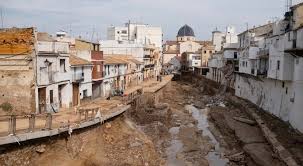
The funnel effect and the brutal flow of the Poyo ravine were key factors in the disaster.
There is a heated debate about who should take responsibility for this “natural disaster”, especially between the leading political party PP, in Valencia, and the central government led by Pedro Sanchez in Madrid. The outcome will probably never be known, but I want to try to explain why this disaster on October 29, 2024, took 229 lives.
The Plan Sur, was a colossal Francoist project that diverted the Turia River and exposes the current government’s shortcomings, after a flood that claimed the lives of 81 people in Valencia in 1957, Franco’s government decided to undertake the largest civil engineering project to date to prevent another tragedy in the future. (this is something that today’s Sanchez regime don’t want to acknowledge)
The Mediterranean coast has suffered for centuries from the ravages of the so-called “Gota Fria,” a sudden torrential downpour that floods and destroys everything in its path. The force of nature is practically uncontrollable, but in 1958, construction projects were approved that would defy the natural order with unprecedented success. In “modern” time the name use for such disasters are called, DANA, (Depresión Aislada en Niveles Altos,) A weather condition that occurs suddenly and cannot be predicted with certainty.
In 2024, a long-term drought had affected large parts of Spain and in this case on the east coast of the Valencia province. There is an enormous amount of cultivated land for the cultivation of vegetables and fruits of various kinds. These large areas have been modernized, with the result that ditch digging to prevent soil erosion has been practically eliminated. This results in that when large amounts of rain, in this case over 400 L/m2 in only one hour, the soil surface becomes liquid in the form of mud, which with enormous force finds its way to the nearest watercourse, in this case the Rio Turia. This is where it all started, long before any authorities understood the seriousness of this flood.
The disaster had begun!
The current government in Madrid has not carried out a follow-up of General Franco’s projects, to prevent the repetition of past events, such as when, Franco’s government embarked on the challenge of confronting the elements and devising a system to protect Valencia from future floods. The proposals were to clean, reinforce, and improve the natural course of the Turia River; divert it to the northern part of Valencia; or undertake a massive project to channel the river through the southern part of the city. This third option was chosen, and despite being the most expensive, the decision was made to implement the Plan Sur (South Plan).
In recent decades, there has been virtually no new ditching or dredging of rivers and streams in Spain. Dredging is a major need at river mouths, so that the water can flow naturally at the mouths towards the seas. In addition, new construction plans have not taken into account future flooding, as preparatory measures by constructing “Storm-water deposits”, which is a relatively low cost in relation to what has happened.
It has already been a whole year since the disaster, and the accusations are still flying between the authorities. What has not been fulfilled, however, is the promised aid of thousands of millions to those affected, and no one is talking about where all the millions donated by volunteers and large companies have gone? Maybe they are in someone’s bank account and generating interest? As I said before, we may never know the final result, only speculate why these lost lives are not respected.
Belém, in the heart of the Brazilian Amazon, serves as the setting for a summit surrounded by environmental urgency… and political disinterest, this year, with a sharp drop in the presence of world leaders.
I have now followed the COP conferences for over 10 years and unfortunately with decreasing interest. The idea from the beginning was to reduce toxic emissions and generally improve the environmental issue globally. This has failed so far and only huge funds have been formed that are distributed to certain developing countries that are run by dictatorships or military powers. Personally, I do not see COP30 in Brazil changing the course of events after studying the upcoming program. A large number of important leaders from major countries are not participating this time, which means that the decisions made, will have less significance.
The list of participants decisionmakers will be relatively small. Brazil has confirmed 57 heads of state and government, with representation from 143 countries, including Spain, who represent the intervention between the different events of nearly 60,000 people. Being relevant figures, they are lower than those of recent years, continuing the downward trend in terms of the convening power of the COPs that was already seen in the 2024 COP in Baku (Azerbaijan).
What’s sad about this gathering is that it will once again be about adding billions more to funds to help the environment. We cannot buy environmental destruction, even the Swedish king asked at the opening of COP30, “How much additional money must be invested in this”?
I have been looking forward to a rapprochement with the world’s difficult water supplies, as the #WaterPositiv organization has invested large resources in being heard this time. But if it is only discussed that the “rescue funds# must be increased again, then I think the water problem will become less important, unfortunately!
What is contradictory to the environment is that a guaranteed number of 60,000 participants, as well as the other 20,000 journalists and news monitors, travel from all over the world by using large amount of jet fuel. Wouldn’t it be the rights time to organize an online meeting instead, to show interest in preserving the environment?
I will report back when there are results from the first days of meetings.
Hay signos de declive en el turismo de la Costa del Sol, con caídas en la ocupación hotelera y un estancamiento en el crecimiento de ingresos en el segundo trimestre de 2025. Factores como la inflación, la pérdida de poder adquisitivo del turista nacional y el aumento de los precios están afectando al sector.
Sin embargo, el balance general del sector puede ser más complejo, ya que otros informes señalan que las previsiones para finales de año son de crecimiento respecto a 2024, y el aeropuerto de Málaga sigue registrando un número elevado de turistas internacionales.
Evidencia del declive
Caída de ocupación y estancias: Se han registrado caídas en la ocupación hotelera en comparación con 2024, especialmente en agosto.
También se ha observado una pérdida de más de 420.000 estancias en alojamientos turísticos hasta mayo.
Estancamiento en ingresos: Un análisis de los datos del II Trimestre de 2025 indica un crecimiento de ingresos hoteleros muy bajo, del 0,9%.
Impacto en la oferta: La bajada se está notando en la afluencia de turistas, con playas, restaurantes y hoteles menos concurridos.
Causas principales
Inflación y precios: La inflación y el aumento de los precios están frenando la capacidad de gasto del turista nacional, un mercado clave para el sector. (Mientras el Gobierno español defiende el nivel actual de inflación.)
Baja competitividad: Se argumenta que la Costa del Sol podría no estar compitiendo eficazmente debido a estos factores.
Perspectivas a futuro
Previsiones optimistas: A pesar de las caídas observadas en el corto plazo, algunas previsiones para el cierre de 2025 esperan que la región iguale los resultados de 2024 en términos de turistas e ingresos.
Impacto de mercados internacionales: El interés de los mercados lejanos es positivo y la Costa del Sol sigue siendo un destino popular, aunque hay una preocupación por el posible impacto del Brexit en el mercado británico.
Factores que influyen.
Desestacionalización: El comportamiento del turista está cambiando, con más viajes fuera de temporada alta. Esto se debe a cambios en las condiciones laborales, como el trabajo remoto, que proporciona una mayor libertad para planificar las vacaciones.
Competencia internacional: Otros destinos están captando parte del mercado que antes elegía la Costa del Sol. Arabia Saudita y Baréin: Han invertido fuertemente en el desarrollo de sus destinos turísticos, con nuevos hoteles y mejores conexiones aéreas. Ofrecen experiencias culturales únicas, como la zona histórica de Al-Ula. Europa del Este: Ha aumentado en popularidad entre los viajeros experimentados que buscan nuevas experiencias, ciudades históricas y precios más bajos.
Turismo nacional debilitado: La pérdida de poder adquisitivo ha reducido la estancia media y el gasto por turista. “Cambio climático”: una tendencia creciente en la que los viajeros eligen climas más fríos para evitar el calor extremo, lo que beneficia a destinos como Suecia y Finlandia.
Falta de renovación: No sólo el sol y la playa interesan al turista actual. La gastronomía y la cultura son importantes para atraer turistas con buenas finanzas, en países del Mediterráneo
Escasez de agua y sequía: Varios países se han visto obligados a racionar el agua debido al cambio climático, algo imprevisto. Piscinas cerradas, no es algo que los turistas quieran ver. Faltan inversiones importantes para mejorar el suministro de agua.
Perspectivas futuras.
El cambio de condiciones puede ser importante para la planificación futura de la industria turística en muchos países. Es necesario reevaluar los ingresos estimados del turismo, entendiendo que no es posible construir la economía de un país basándose en esta industria.
El turismo sostenible, el bienestar y la salud, los viajes a medida y las experiencias auténticas, la digitalización (incluido el “set-jetting” y la IA), y los viajes en solitario .Son medidas importantes para mantener el flujo de turistas en la industria turística